Product Description
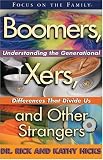
Ever wonder why your kids, parents, and even coworkers think and feel so differently than you do on core issues? Rick and Kathy Hicks contend and demonstrate that many of our core values are shaped largely by what was going on in our culture and world when we were about ten years old. By recognizing the factors that give rise to our own values and those of other generations, we can achieve greater mutual understanding and reconciliation with our children, peers, and coworkers, rather than finding ourselves in conflict. An effective tool for bridging the generation gap.
Rate Points :3.5
Binding :Paperback
Label :Focus
Manufacturer :Focus
ProductGroup :Book
Studio :Focus
Publisher :Focus
EAN :9781561796779
Price :$10.99USD
Lowest Price :$4.50USD
Customer ReviewsBoomers, X ers, and other strangers
Rating Point :5 Helpful Point :2
Enjoyed the book very much. I can use the information in my daily dealings with people.
Builders vs. Everyone Else?
Rating Point :2 Helpful Point :2
The authors bring out a few interesting points, but this book seems to be aimed towards reconciliation between builders (pre WW2 generation) and the rest of us. It paints a picture of each generation that could at best be called cartoonish. At worst, the picture painted is stereotypical generalizations drawn from a world where everyone is white and generations are easily classified. The chief problem with this book is its age. It fails to paint an accurate picture of todays generational divides due to its age.
This book does create some interesting thoughts, but would be most useful in an aging church that is trying to change its mission to include younger generations.
Ultimately unsatisfying
Rating Point :2 Helpful Point :10
This book has a few pieces of useful information ... but overall there are many much better books out there about generations and how they differ (e.g., Generation Me, When Generations Collide, Generations). The authors take a spattering of information from other sources (they are not researchers or policy makers themselves), tell a few narratives, and thats about it. You are much better off buying another book on generations.
Also, notice the publisher: Focus on the Family. Thus the book is written from an explictly stated Christian perspective. For some readers this might be a bonus others might be put off by this in a book that is not about religion.
A History of Change and Values in America
Rating Point :4 Helpful Point :2
It was very helpful to explain generational differences using a decade analysis approach. Stories and conversations used to illustrate the socio-economic and technological changes for each decade were also helpful in giving the reader a better understanding of how much impact each decade has on our values and perspectives. Although the authors base their assumptions that character and personality are determined around age 10, his theoretical model is quite accurate in helping assess each decade.If I dont give it a 5 it is because in my opinion the book does not reveal any new facts not explored before that talk about generational differences. The differences between Baby Boomers and other generations have been a long-discussed topic. Nevertheless, the fact that they bothered discussing each decade and its impact on values in America is engaging and invites for further discussion on this issue.
boo to "soccer moms" and hurray for working women everywhere
Rating Point :2 Helpful Point :6
I agree with the previous reviewer who wrote of the guilt trip that this book gives to working mothers. I am an Australian who is residing in the USA, and I am shocked and appalled at the American attitude towards working mothers. In Australia it is the norm for women to pursue careers and work in fulltime jobs, whether they are single, married, de facto, mothers, young, old, whatever. Childcare is a policy issue for government, is often subsidised, and considered imperative for the growth of the economy and the wellbeing of the community. What assistance does the American government give to working mothers?! How does the American media portray mothers of Generation X?! The attitude here is so far behind it is laughable. For American authors to claim authority over subjects such as Generation X and its place on the world stage, they will need to update their ideas and look to other societies as well as their own.
Similar ItemGenerations at Work: Managing the Clash of Veterans, Boomers, Xers, and Nexters in Your Workplace  Walk through the tightly packed, hierarchically flattened corridors of Americas businesses and what do you hear? Not the sounds of harmony. Instead, youll probably hear the grumbles of irritation as people with wholly different ways of working, talki
Bridging the Generation Gap: How to Get Radio Babies, Boomers, Gen Xers, And Gen Yers to Work Together And Achieve More  Miscommunication Employee conflict Work ethic debates Loyalty issues Varying wants and needs If you are a manager, human resources professional, or business owner, you are faced with these types of issues every day. But why? Because current
Generations: The History of America's Future, 1584 to 2069  Hailed by national leaders as politically diverse as former Vice President Al Gore and former House Speaker Newt Gingrich, Generations has been heralded by reviewers as a brilliant, if somewhat unsettling, reassessment of where America is heading.Wil
When Generations Collide: Who They Are. Why They Clash. How to Solve the Generational Puzzle at Work  If your workplace feels like a battle zone and colleagues sometimes act like adversaries, you ore not alone. Today four generations glare at one another across the conference table, and the potential for conflict and confusion has never been greater
Millennials Rising: The Next Great Generation  Amazon.com ReviewBuilding on the concepts they first developed in Generations and 13th Gen, Neil Howe and William Strauss now take on Generation Y, or, as they call them, the Millennials. Unlike their rather distressing portrait of the more reactive
Walk through the tightly packed, hierarchically flattened corridors of Americas businesses and what do you hear? Not the sounds of harmony. Instead, youll probably hear the grumbles of irritation as people with wholly different ways of working, talkiMiscommunication Employee conflict Work ethic debates Loyalty issues Varying wants and needs If you are a manager, human resources professional, or business owner, you are faced with these types of issues every day. But why? Because currentHailed by national leaders as politically diverse as former Vice President Al Gore and former House Speaker Newt Gingrich, Generations has been heralded by reviewers as a brilliant, if somewhat unsettling, reassessment of where America is heading.Wil If your workplace feels like a battle zone and colleagues sometimes act like adversaries, you ore not alone. Today four generations glare at one another across the conference table, and the potential for conflict and confusion has never been greaterAmazon.com ReviewBuilding on the concepts they first developed in Generations and 13th Gen, Neil Howe and William Strauss now take on Generation Y, or, as they call them, the Millennials. Unlike their rather distressing portrait of the more reactive 
0 ความคิดเห็น:
แสดงความคิดเห็น