Product Description
Amazon.com Review
Book Description
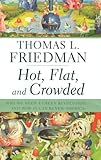
Thomas L. Friedmans phenomenal number-one bestseller The World Is Flat has helped millions of readers to see the world in a new way. In his brilliant, essential new book, Friedman takes a fresh and provocative look at two of the biggest challenges we face today: Americas surprising loss of focus and national purpose since 9/11 and the global environmental crisis, which is affecting everything from food to fuel to forests. In this groundbreaking account of where we stand now, he shows us how the solutions to these two big problems are linked--how we can restore the world and revive America at the same time.
Friedman explains how global warming, rapidly growing populations, and the astonishing expansion of the worlds middle class through globalization have produced a planet that is hot, flat, and crowded. Already the earth is being affected in ways that threaten to make it dangerously unstable. In just a few years, it will be too late to fix things--unless the United States steps up now and takes the lead in a worldwide effort to replace our wasteful, inefficient energy practices with a strategy for clean energy, energy efficiency, and conservation that Friedman calls Code Green.
This is a great challenge, Friedman explains, but also a great opportunity, and one that America cannot afford to miss. Not only is American leadership the key to the healing of the earth it is also our best strategy for the renewal of America.
In vivid, entertaining chapters, Friedman makes it clear that the green revolution we need is like no revolution the world has seen. It will be the biggest innovation project in American history it will be hard, not easy and it will change everything from what you put into your car to what you see on your electric bill. But the payoff for America will be more than just cleaner air. It will inspire Americans to something we havent seen in a long time--nation-building in America--by summoning the intelligence, creativity, boldness, and concern for the common good that are our nations greatest natural resources.
Hot, Flat, and Crowded is classic Thomas L. Friedman: fearless, incisive, forward-looking, and rich in surprising common sense about the challenge--and the promise--of the future.
Thomas Friedman and Fareed Zakaria: Author One-to-One
Fareed Zakaria: Your book is about two things, the climate crisis and also about an American crisis. Why do you link the two? 
Thomas Friedman: Youre absolutely right--it is about two things. The book says, America has a problem and the world has a problem. The worlds problem is that its getting hot, flat and crowded and that convergence--that perfect storm--is driving a lot of negative trends. Americas problem is that weve lost our way--weve lost our groove as a country. And the basic argument of the book is that we can solve our problem by taking the lead in solving the worlds problem.
Zakaria: Explain what you mean by "hot, flat and crowded."
Friedman: There is a convergence of basically three large forces: one is global warming, which has been going on at a very slow pace since the industrial revolution the second--what I call the flattening of the world--is a metaphor for the rise of middle-class citizens, from China to India to Brazil to Russia to Eastern Europe, who are beginning to consume like Americans. Thats a blessing in so many ways--its a blessing for global stability and for global growth. But it has enormous resource complications, if all these people--whom youve written about in your book, The Post American World--begin to consume like Americans. And lastly, global population growth simply refers to the steady growth of population in general, but at the same time the growth of more and more people able to live this middle-class lifestyle. Between now and 2020, the worlds going to add another billion people. And their resource demands--at every level--are going to be enormous. I tell the story in the book how, if we give each one of the next billion people on the planet just one sixty-watt incandescent light bulb, what it will mean: the answer is that it will require about 20 new 500-megawatt coal-burning power plants. Thats so they can each turn on just one light bulb!
Zakaria: In my book I talk about the "rise of the rest" and about the reality of how this rise of new powerful economic nations is completely changing the way the world works. Most everyones efforts have been devoted to Kyoto-like solutions, with the idea of getting western countries to reduce their carbon dioxide emissions. But I grew to realize that the West was a sideshow. India and China will build hundreds of coal-fire power plants in the next ten years and the combined carbon dioxide emissions of those new plants alone are five times larger than the savings mandated by the Kyoto accords. What do you do with the Indias and Chinas of the world? Friedman: I think there are two approaches. There has to be more understanding of the basic unfairness they feel. They feel like we sat down, had the hors doeuvres, ate the entre, pretty much finished off the dessert, invited them for tea and coffee and then said, "Lets split the bill." So I understand the big sense of unfairness--they feel that now that they have a chance to grow and reach with large numbers a whole new standard of living, were basically telling them, "Your growth, and all the emissions it would add, is threatening the worlds climate." At the same time, what I say to them--what I said to young Chinese most recently when I was just in China is this: Every time I come to China, young Chinese say to me, "Mr. Friedman, your country grew dirty for 150 years. Now its our turn." And I say to them, "Yes, youre absolutely right, its your turn. Grow as dirty as you want. Take your time. Because I think we probably just need about five years to invent all the new clean power technologies youre going to need as you choke to death, and were going to come and sell them to you. And were going to clean your clock in the next great global industry. So please, take your time. If you want to give us a five-year lead in the next great global industry, I will take five. If you want to give us ten, that would be even better. In other words, I know this is unfair, but I am here to tell you that in a world thats hot, flat and crowded, ET--energy technology--is going to be as big an industry as IT--information technology. Maybe even bigger. And who claims that industry--whose country and whose companies dominate that industry--I think is going to enjoy more national security, more economic security, more economic growth, a healthier population, and greater global respect, for that matter, as well. So you can sit back and say, its not fair that we have to compete in this new industry, that we should get to grow dirty for a while, or you can do what you did in telecommunications, and that is try to leap-frog us. And thats really what Im saying to them: this is a great economic opportunity. The game is still open. I want my country to win it--Im not sure it will.
Zakaria: Im struck by the point you make about energy technology. In my book Im pretty optimistic about the United States. But the one area where Im worried is actually ET. We do fantastically in biotech, were doing fantastically in nanotechnology. But none of these new technologies have the kind of system-wide effect that information technology did. Energy does. If you want to find the next technological revolution you need to find an industry that transforms everything you do. Biotechnology affects one critical aspect of your day-to-day life, health, but not all of it. But energy--the consumption of energy--affects every human activity in the modern world. Now, my fear is that, of all the industries in the future, thats the one where were not ahead of the pack. Are we going to run second in this race?
Friedman: Well, I want to ask you that, Fareed. Why do you think we havent led this industry, which itself has huge technological implications? We have all the secret sauce, all the technological prowess, to lead this industry. Why do you think this is the one area--and its enormous, its actually going to dwarf all the others--where we havent been at the real cutting edge?
Rate Points :4.0
Binding :Hardcover
Label :Farrar, Straus and Giroux
Manufacturer :Farrar, Straus and Giroux
ProductGroup :Book
Studio :Farrar, Straus and Giroux
Publisher :Farrar, Straus and Giroux
EAN :9780374166854
Price :$27.95USD
Lowest Price :$14.49USD
Customer ReviewsGreat book!
Rating Point :5 Helpful Point :0
I love the book! It came really fast. I would buy from this seller again!
What can you say?
Rating Point :1 Helpful Point :2
about a guy who supported the Iraq war but became a big opponent the moment the going got tough,as happens in most wars. This guy would have surrendered in WW2 after the Phillipines. You can choose to believe the man made global warming hoax,or you can write all day long about green energy,the fact remains until some economical viable solutions,fossil fuels rule. taxing fossil fuels to make them more viable is insane. the world is in a panic as oil falls back to 20 a barrel as it has before. guys like Freidmand,Obama,and Gore can only scream fire in the theater so often. Waste of money.
World is flat-tire
Rating Point :2 Helpful Point :0
"The Lexus and the Olive Tree" was unique in its point of view. The writing was instructive and entertaining. Friedmans follow-up book, "The World is Flat," was a hit! New insight into seeing the world as it "is."
"Hot, Flat and Crowded" interprets the meaning of the word "is." Long-winded and lumpy, oft times boring, Friedman must have written this in Minneapolis while looking out the window. No new insight, here. Me thinks he went to the well once too often in this book.
Hell, who wants to pay $5/gal tax on gasoline to cut consumption of Arab oil? Why should everyone in the world be entitled to buy a car on some kind of subprime deal. The answer, Tom, is new kinds of energy, not how to make oil last longer as the fuel of choice.
Skip this one. You wont miss anything. Im sure Tom is working on a new book now that Obama is "in" and his Nobel Prize energy secretary at Livermore Berkeley National Laboratory is working on
an answer to Arab (and Russian) oil. Maybe a combination of wind, hot air and the atomic bomb!
A new way to view GREEN
Rating Point :5 Helpful Point :0
This book is a must read for any voting citizen. You may not like what he has to say but you should read it anyway. The book will help anyone understand the subject. The recent election and statements from the President elect shows how the Green issue is a major shapping force in American politics. Many people are worshiping at the Green alter. I know many dont understand what this Green thing is. Many view it as a feel good issue like dont club Baby seals. There isnt much argument to that. To others the green issue is a starting point to the one world government bent on destruction. This book shapes that issue in a new way that will help all parties. No matter what you believe this issue will truly haunt us in many different ways over the next few years.
Thomas Friedman here captures the issue like nothing else. Most books on the subject are nothing but sad stories about Bambi and the other creatures of the forest from nasel sounding failed politicians. All of those books were written by rich ex-politicans or whinny university professors who all dont have to worry about where their next meal is coming from. To 90% of the world living in the edge of poverty the Green religion has different meanings. This book takes a radically new approach to explaining things. He both shows the importance of the isse but tempers it with some reality.
Thomass reality on the world is a good read. The first half of the book shows in great detail the status of the world. He in very clear detail shows how population for the third world is going through the roof. Then he discusses the impact from that unrestrained growth. This growth has a huge impact on other things and vice versa. Growing populations need more energy. As they burn that energy damage from pollution grows and the demand on supply increases pushing up price. Friedmans discussion of this angle is excellent. It is clear, concise, and very believable. Christians who read it will swear they are reading a description of the last days, though Mr. Friedman doesnt talk about that. He says the pressure from this situation demands a "Green Revolution".
His ideas on how to start this revolution is really thought provoking. He has very specific ideas like a new electrical grid system for the country or how to use R&D monies to prime the research pump. Friedmans ideas do seem to rely heavily on optimism and humanism. His descriptions are very clear and entertaining. He has some little known stories that really enrich the story and do give hope. The stories make the issue real and not some vague ideology ex-liberals like to preach.
He does have some ideas worth exploring on the policy front. The recent President elects radio speeches sound like he has read this book. I am sure we all will see these ideas debated on TV news over the next year or so. That is why I think everyone should read this book. It will help you understand events.
Our childrens future - a must read!
Rating Point :5 Helpful Point :0
Thomas Friedman brilliantly summarizes our chlidrens future if the world doesnt take a solidly green stand. Though initially terrifying, he does give us hope if the US government and businesses take action. Wake up America! Our families lives depend upon it. This book should be on everyones bedside table.
 Zakaria . . . may have more intellectual range and insights than any other public thinker in the West. Boston Sunday Globe This is not a book about the decline of America, but rather about the rise of everyone else. So begins Fareed Zakarias blo
 In this stunning new book, Malcolm Gladwell takes us on an intellectual journey through the world of "outliers"--the best and the brightest, the most famous and the most successful. He asks the question what makes high-achievers different? His answer
0 ความคิดเห็น:
แสดงความคิดเห็น